
Why DIY Rat Baits Often Fail in Roof Voids
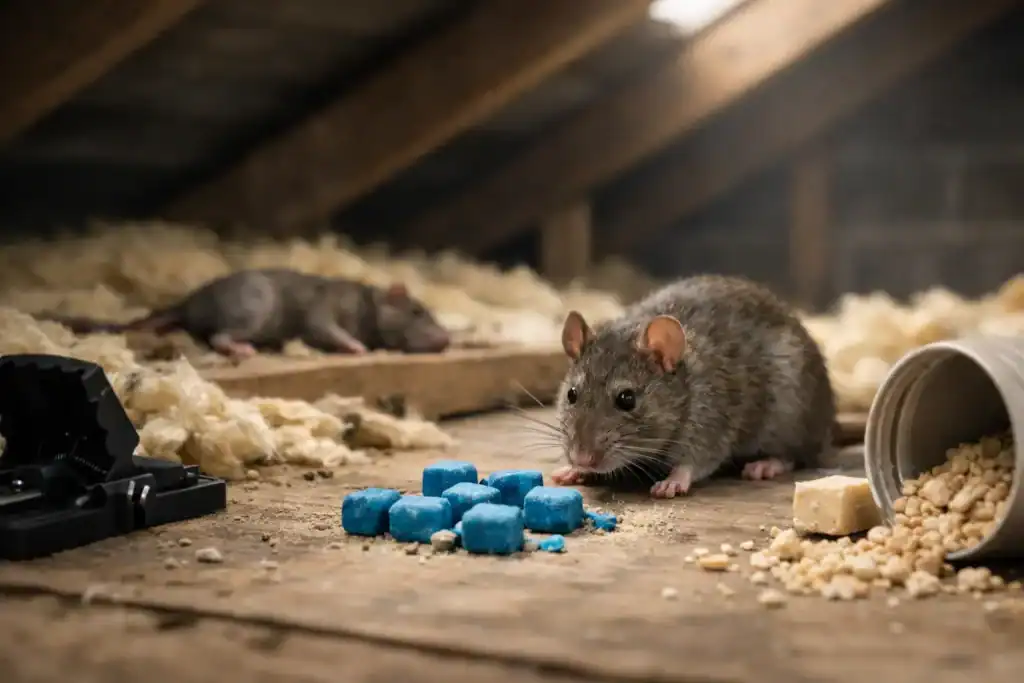
You hear scratching above the ceiling at 2 am, set out a few baits from the hardware shop, and expect the problem to sort itself out. Then the noise keeps going. That is usually the point where homeowners start asking why DIY rat baits often fail in roof voids, especially when the packets promise quick results. The short answer is that roof spaces are hard to treat properly, rats are cautious, and bait alone rarely fixes the reason they are there in the first place.
Why DIY rat baits often fail in roof voids
A roof void is not an open room where rodents wander in plain sight. It is a tight, dark network of insulation, wiring, timber, dust, and hidden entry paths. Rats can move through it without ever crossing the exact spot where a DIY bait has been placed.
That matters because baiting is not just about putting poison somewhere in the roof and hoping for the best. Effective control depends on understanding travel routes, nesting behaviour, food competition, moisture sources, and how rats react to unfamiliar objects. If any one of those factors is missed, the treatment can underperform or fail completely.
Rats do not move through roof voids randomly
Rats tend to follow edges, beams, pipes, cables, and repeated runways. They often use the same protected routes night after night. If bait is set in the wrong section of the roof void, they may never find it, or they may investigate it and avoid it.
This is one of the biggest gaps with DIY treatment. Without a proper inspection, it is easy to place bait where access is convenient for people rather than where rats actually travel. In many homes, those are two very different things.
Roof voids often contain better food than bait
A bait needs to compete with whatever else the rats already have access to. That could be pet food in the laundry below, fruit trees in the yard, bins that are not sealed properly, compost, bird seed, or food waste around an outdoor entertaining area. In some properties, roof rats also have easy access to water from condensation, plumbing issues, or nearby gutters.
If a rat is already feeding well, a store-bought bait may not be appealing enough to draw much interest. This is especially true where a small infestation has had time to settle in and establish reliable food sources.
Why roof void conditions make baiting harder
Roof spaces look simple from below, but they are one of the more difficult areas to treat safely and thoroughly. Temperature swings, dust, insulation, and limited access all work against a quick fix.
Placement is often unsafe or ineffective
Many DIY baits are placed near the manhole because that is the easiest area to reach. Unfortunately, that is rarely the most active part of the infestation. A roof void may have several sections that are awkward to access, and activity can be concentrated near eaves, wall cavities, or corners far from the entry point.
There is also the safety issue. Loose bait in a roof void creates avoidable risk. Children and pets may not reach the roof, but native wildlife, secondary exposure, and contamination concerns still matter. In family homes, schools, strata buildings, and workplaces, safe containment and targeted placement are not optional extras.
Rats can be suspicious of new objects
Rats are not reckless. They are often wary of unfamiliar items introduced into their environment, a behaviour known as neophobia. In practical terms, that means they may avoid fresh bait stations or newly placed bait long enough for the homeowner to assume the treatment is not working, or to keep adding more product in frustration.
That can create another problem. More bait does not always mean better control. If it is used without a clear plan, it can increase risk without improving results.
One rat problem can actually be several access problems
People often focus on the noise in the ceiling and treat the roof void as the whole issue. In reality, the roof is usually just where the rats are nesting or travelling. The real problem may be broken roof tiles, gaps around service lines, overhanging branches, uncapped wall voids, damaged eaves, or entry points around solar cabling.
If those access points stay open, new rats can keep entering even after some have taken bait. That is why a bait-only approach often feels like it works briefly, then fails all over again.
The hidden risks of getting it partly right
The frustrating thing about DIY baiting is that it can sometimes reduce activity for a short period. That gives the impression the problem is under control, when in fact only part of the population has been affected.
A surviving rat pair in a sheltered roof void can rebuild numbers faster than many people expect. If nesting conditions remain favourable, the sounds usually return within weeks or months. For the property owner, it feels like the rats never really left.
There is also the issue no one wants to deal with – dead rodents in inaccessible areas. When bait is used without a broader treatment plan, rats may die in wall cavities, between floors, or in hard-to-reach sections of the roof. That can lead to odour, insect activity, and a second pest issue that is far harder to manage than the original scratching noise.
What works better than DIY bait alone
The most reliable approach combines inspection, targeted treatment, and proofing advice. That starts with finding where the rats are getting in, where they are nesting, and what is supporting the infestation.
Inspection changes everything
A proper inspection looks for more than droppings and gnaw marks. It identifies likely entry points, movement paths, nesting material, moisture issues, and nearby food sources. In homes around Sydney, that can include thick garden coverage, overhanging trees, stored goods in garages, and roofline gaps that are easy to miss from ground level.
Once those factors are understood, treatment can be tailored to the property rather than guessed at. That usually means better results with less unnecessary product.
Targeted control is more effective and safer
Professional rodent control in roof voids is not just about stronger products. It is about using the right method, in the right place, with the right level of containment and follow-up. Depending on the site, that may involve secured baiting systems, trapping strategies, exclusion recommendations, and ongoing monitoring.
There is no single answer for every property. A detached family home, a strata complex, and a food business all need different levels of control and compliance. What stays consistent is the need to manage risk while removing the infestation properly.
Exclusion is what stops the cycle
This is the part many DIY attempts miss. If entry points are left open, rats will keep testing the property. A treatment can knock down current activity, but exclusion is what helps prevent repeat infestations.
That may involve sealing gaps, trimming branches away from the roofline, improving rubbish storage, fixing damaged vents, and reducing easy food access around the home. None of that is flashy, but it is often the difference between a short-term result and lasting relief.
When to stop trying DIY rodent baiting
If you have already baited the roof and still hear movement after a reasonable period, it is time to reassess. The same applies if the activity seems to shift from one part of the ceiling to another, if there is a strong smell, or if you are dealing with a property where pets, children, tenants, or shared building access make safety more complex.
Persistent roof noise is a sign that the infestation has not been understood properly yet. At that stage, repeating the same DIY step usually means more delay, more mess, and more risk of hidden damage to wiring, insulation, and timber.
For many households, the real value of professional help is not just rodent removal. It is the peace of mind that the treatment is being handled in a way that protects the people, pets, and wildlife around the property. That is especially important when you want an effective result without using more chemical than necessary.
Clean & Green Pest Control sees this often in family homes where people have done their best with supermarket or hardware-store products and simply hit the limits of what DIY can achieve in a roof void. That is not a failure on the homeowner’s part. It is a sign that the problem needs a more informed approach.
If rats are active above your ceiling, the goal should not be to scatter more bait and hope for silence. The better path is to find out why they are there, how they are moving, and what will stop them coming back. That is how you turn a recurring roof problem into a manageable one.